
Fabiola Menchelli: our sharp line of sight

Marshall Gallery presents our sharp line of sight, Fabiola Menchelli’s third solo exhibition with the gallery, on view September 11th – November 7th, 2026. The exhibition brings together two dozen unique prismatic, camera-less chromogenic works. Installed in a darkened space, each photo-sculptural piece is suspended within a custom color-matched shadowbox frame, where folds, gradients, and planes register as both luminous images and physical forms.


-
 Fabiola Menchelli, our sharp line of sight (nuestra nítida línea de visión), 2024
 -
Fabiola Menchelli, glass-off, 2026
-
Fabiola Menchelli, green supercell, 2025
-
Fabiola Menchelli, fire wire, 2025
-
Fabiola Menchelli, with your hand on my back (con tu mano en mi espalda), 2024
-
Fabiola Menchelli, morse pulse, 2024
-
Fabiola Menchelli, quantum vector, 2026
-
Fabiola Menchelli, Scarlet, 2026
-
Fabiola Menchelli, soft boundaries, blind knots (límites suaves, nudos ciegos), 2024


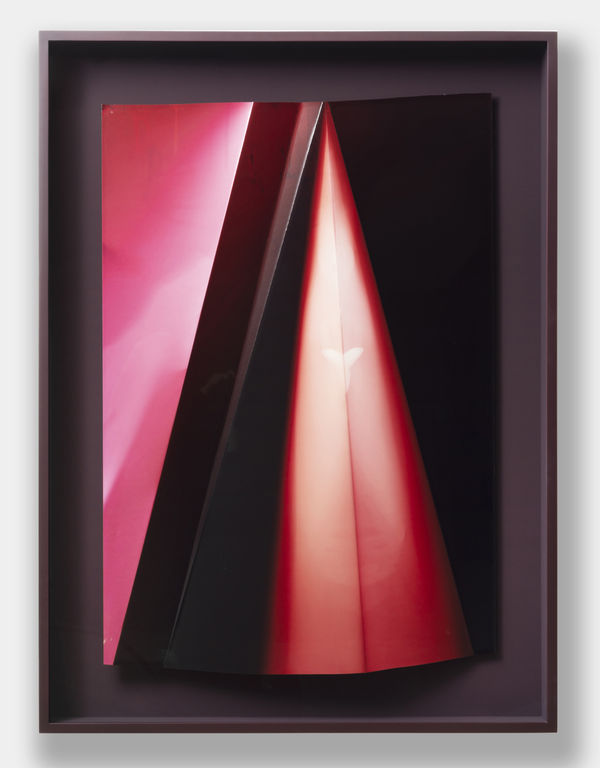


Marshall Gallery presents our sharp line of sight, Fabiola Menchelli’s third solo exhibition with the gallery, on view September 11th – November 7th, 2026. The exhibition brings together two dozen unique prismatic, camera-less chromogenic works. Installed in a darkened space, each photo-sculptural piece is suspended within a custom color-matched shadowbox frame, where folds, gradients, and planes register as both luminous images and physical forms.
Working directly with photosensitive color paper and light, Menchelli works in the darkroom without a camera. She folds, handles, exposes, and develops the paper in total darkness, where the image remains unseen. It emerges through touch, duration, chemistry, and the paper’s own resistance. “The work responds to darkness, not to my wishes,” Menchelli says. “It requires time, space, and a willingness to remain uncertain.” Her photographs do not describe a world already visible; they make room for encounters with what is unstable, partially known, or just beyond sight.
In The Foreign Legion (1964), Clarice Lispector writes: “In painting as in music and literature, what is called abstract so often seems to me the figurative of a more delicate and difficult reality, less visible to the naked eye.”1 The quotation offers one way into Menchelli’s approach to abstraction: not as an escape from the world, but as sustained attention to what exceeds immediate recognition. Through light, paper, and darkroom processes, her images make perception felt as physical and contingent.
Menchelli’s series Queer Horizons approaches experimentation not as a formal end in itself, but as a poetic way of making space for possibility. After folding the paper to form two diagonal lines, she exposes the print to light, then immerses the fold in chemistry first, allowing color to bleed along its crease. These unstable horizons undo the fixed vantage point traditionally promised by landscape and photography alike. They address orientation as provisional and relative, shaped by bodies, desire, and movement, in order to imagine possible alternative futures.
Colors carry a related charge. Reds and magenta, in particular, recur throughout Menchelli’s recent works and the gallery’s installation. Magenta first developed through her use of a green filter chosen in reference to the green scarves of la Marea Verde (The Green Wave), a feminist movement across Latin America advocating for reproductive autonomy and women’s rights. Within the positive/negative logic of analog photography, magenta becomes green’s chromatic inverse. Over time, that inversion has carried other meanings. At shorter exposures, the color appears as a pale pink; with longer exposure, it gradually deepens into an electric, unapologetic magenta. Rather than illustrating a political position, she lets history surface through the material language of the darkroom.
Menchelli’s work enters into dialogue with the Light and Space movement through its attention to light, perceptual experience, and the viewer’s bodily position. Her approach, however, remains rooted in photography’s specific material conditions. The works not only depict light or make it visible; they register its contact with the body. In with your hand on my back, the shadow of the artist’s fingertips presses from behind the photographic surface, leaving a trace of the encounter between hand, paper, and light. The image holds the labor of its making: the body is not outside the photograph, but inseparable from it.
Installed in a darkened space, our sharp line of sight invites viewers to slow down as their eyes adjust to its chromatic array. Menchelli’s photographs do not offer a stable record of a world already known. They make the act of looking palpable, shaped by duration, position, and the body. Rather than resolving vision into a single, sharp line of sight, the exhibition opens a wider field.
Fabiola Menchelli (b. 1983, Mexico City) is an artist working with photography and expanded image practices. Her work has recently been presented at the Norton Museum of Art, West Palm Beach (2025); The Contemporary at Blue Star, San Antonio (2025); Douglas F. Cooley Gallery, Portland (2023); and Arróniz Arte Contemporáneo, Mexico City (2022). She has been a visiting artist at institutions in Mexico and the United States and is currently core faculty at the Seminario de Producción Fotográfica at Centro de la Imagen. Menchelli lives and works in Mexico City.
Works from Menchelli’s series Queer Horizons recently entered the collection of the J. Paul Getty Museum. The exhibition coincides with the Getty’s fall presentation Instante/revelación: Moments in Mexican Photography, curated by Julieta Pestarino. Menchelli’s work is also held in the collections of the Norton Museum of Art, Pérez Art Museum Miami, Eskenazi Museum of Art, Centro de la Imagen in México City, Museo de Arte Carrillo Gil, and the JPMorgan Chase Art Collection.
For more information, please contact the gallery: 310-413-3987 | info@marshallgallery.art
1 Clarice Lispector (1920–1977) was a Brazilian writer born in Ukraine, known for her experimental, introspective prose and stream-of-consciousness style. The quotation is reproduced in Benjamin Moser, “The True Glamour of Clarice Lispector,” The New Yorker, July 10, 2015.
